LSPHIL › Writing systems & orthography › How Baybayin Letters Work: A Primer on the Philippines' Abugida Script
How Baybayin Letters Work: A Primer on the Philippines' Abugida Script
A single Baybayin sign is never just a consonant. Take the curved stroke ᜊ: that shape carries both a /b/ and the vowel /a/ together, so it is read "ba." The reader who wants to write "bi" or "bu" does not choose a different letter. Instead, she places a small mark—a kudlít—either above or below the same base shape, and the vowel shifts. This is the mechanism that defines Baybayin not as an alphabet but as an abugida, a script family found across South and Southeast Asia where consonant signs wear their vowels on the surface.
English · 1004 words
The Default Vowel and the Two Kudlíts
The Baybayin character set runs to 17 base signs: 14 consonants and 3 independent vowels. In their unmarked form, every consonant carries the vowel /a/. The kudlít placed above the character switches that vowel to /e/ or /i/; placed below, it produces /o/ or /u/. The mark itself is a small stroke or dot, historically written with the same pen or brush that formed the letter. There are no separate letters for /be/, /bi/, /bo/, /bu/—only the base shape and the two positions of the diacritic.
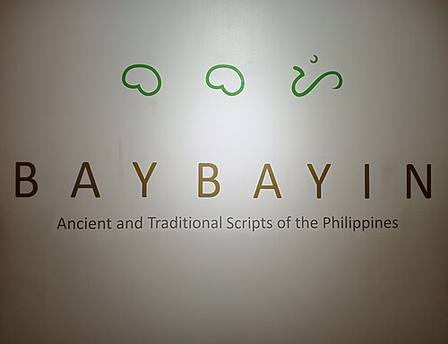
This economy is the point. An alphabet assigns individual symbols to consonants and vowels alike, requiring the writer to line up two or three glyphs for every syllable. An abugida packs the syllable into one unit. The reader learns fourteen shapes, not fifty-six, and reads by recognizing the base plus its modifier. The system assumes that the vowel /a/ is the normal state of a syllable, and that departures from that norm are the marked case. Linguists call this an "inherent vowel," and in Baybayin that inherent vowel is always /a/.
What Baybayin Writes and What It Leaves Out
Classical Baybayin writes syllables, not letter strings, and it does not write every syllable that a modern spelling would demand. A syllable that ends in a consonant—a final /m/, /n/, /ng/, /l/, /r/, or the glottal stop—was simply not represented in the traditional system. The word bantay (to watch) would be written ᜊ ᜈ ᜆ, read "ba-na-ta," with no mark showing the final /y/. The reader supplied the closing consonants from knowledge of the word or from the surrounding sentence.
A later mark, called sabat or krus and functioning as a virama, removes the inherent vowel from a consonant sign. This allows a base character to stand alone without its vowel, and so permits the writing of final consonants. But this is a reformed usage. In the classical system described in traditional sources, if a consonant is not pronounced with a vowel, it is not written. The script writes by sound, not by modern orthography, and the sound it captures is the open syllable.
Why It Is Not an Alphabet
The distinction matters because it shapes how a reader processes the page. In an alphabet like Roman or Cyrillic, the letter <b> represents only the consonant sound; the reader must add a separate vowel sign to make "ba" or "be." In Baybayin, the sign ᜊ already contains the vowel. The independent vowel letters—ᜀ for /a/, ᜁ for /e/ or /i/, ᜂ for /o/ or /u/—exist only for syllables that begin with a vowel sound. They are not the default. The default is the consonant-vowel unit, and the three independent vowels are supplementary characters for the minority of syllables that lack an initial consonant.
This structure is why Baybayin is classified with Devanagari, Khmer, Thai, and other abugidas rather than with true alphabets. The typographic unit is the syllable, and the graphic variations on a base sign are read as phonemic modifications of that syllable, not as separate letters to be assembled.
Reading the Ambiguity
The classical system's silence on final consonants creates a built-in ambiguity. The sequence ᜊ ᜈ ᜆ could represent bantay, but also banta (threat), banata (a vow), or other combinations depending on which final consonants the reader supplies and whether she hears a glottal stop. Traditional Baybayin assumes that context will settle the reading. The same source that notes the omission of final consonants emphasizes that the script writes words by sound rather than by spelling, and that the reader reconstructs the intended word from what is on the page plus what she knows of the language.
This is not a defect in the system. It is a feature of its design, inherited from the broader South Asian tradition of syllabic writing. The trade-off is graphic simplicity against reader effort: fewer marks on the stone or bamboo, more inference required of the person reading them.
A Practical Reading Table
The 14 consonant base signs and their three vowel states can be summarized from the general rule. Below, representative consonants show the pattern; the same kudlít placement applies to every base in the set.
| Base (/a/) | With kudlít above (/e, i/) | With kudlít below (/o, u/) |
|---|---|---|
| ᜊ ba | ᜊᜒ bi | ᜊᜓ bu |
| ᜃ ka | ᜃᜒ ki | ᜃᜓ ku |
| ᜇ da/ra | ᜇᜒ di/ri | ᜇᜓ du/ru |
| ᜄ ga | ᜄᜒ gi | ᜄᜓ gu |
| ᜑ ha | ᜑᜒ hi | ᜑᜓ hu |
| ᜎ la | ᜎᜒ li | ᜎᜓ lu |
| ᜋ ma | ᜋᜒ mi | ᜋᜓ mu |
| ᜈ na | ᜈᜒ ni | ᜈᜓ nu |
| ᜅ nga | ᜅᜒ ngi | ᜅᜓ ngu |
| ᜉ pa | ᜉᜒ pi | ᜉᜓ pu |
| ᜐ sa | ᜐᜒ si | ᜐᜓ su |
| ᜆ ta | ᜆᜒ ti | ᜆᜓ tu |
| ᜏ wa | ᜏᜒ wi | ᜏᜓ wu |
| ᜌ ya | ᜌᜒ yi | ᜌᜓ yu |
The three independent vowels stand alone: ᜀ a, ᜁ e/i, ᜂ o/u. No base consonant is needed.
The Act of Reconstruction
Because Baybayin suppresses final consonants and builds each syllable from a base plus optional diacritic, reading it is not decoding in the alphabetic sense. The reader does not transcribe letter by letter. She recognizes syllabic units, applies the vowel marks, and then—crucially—reconstructs what is missing. The script gives her the open syllables; she supplies the closures from memory and context. This is the abugida bargain, and it is why a page of Baybayin, even when the characters are perfectly legible, can still be read in more than one way.
The register
What the rail used to do: newest, more on this desk, other languages.
- How to Classify Any Script in Two Questions: What One Sign Means, and What Happens When the Vowel ChangesEnglish · 915 words
- Do Accent Marks Change Meaning? It Depends on the Language's RulesEnglish · 1009 words
- Why Spelling Reforms Succeed in Some Languages and Collapse in OthersEnglish · 987 words
- The Hidden Barrier Between a Script and Your KeyboardEnglish · 875 words
In other languages
- Cómo se escriben los nombres extranjeros en español: transferencia, adaptación o tradiciónEspañol · 958 words
- Warum das Deutsche Substantive großschreibt – und was das im Satz leistetDeutsch · 874 words
- Hvorfor dansk staves anderledes end det udtalesDansk · 641 words
- Casino bonussenNederlands · 782 words
Newest on the site
- What You Can Actually Do at B1 Level (and What the CEFR Never Promises)English · 1074 words
- How Many Words to Read a Newspaper? The Answer Depends on What You CountEnglish · 807 words
- Why Spaced Repetition Stops Working: The Interval Is Not the ProblemEnglish · 724 words
- Mother-Tongue Instruction Is Not a Slogan: The DepEd Orders That Actually Define Philippine MTB-MLEEnglish · 1072 words