LSPHIL › Writing systems & orthography › Why Spelling Reforms Succeed in Some Languages and Collapse in Others
Why Spelling Reforms Succeed in Some Languages and Collapse in Others
English spelling reform has never failed for lack of good ideas. It has failed because, as the English Spelling Society itself notes, "no-one has the authority to drive spelling reform." The organization, promoting simplified spelling, now pins its hopes on an International English Spelling Congress—a body that does not yet exist and would have no enforcement power if it did. This institutional vacuum explains why English retains spellings like "through," "cough," and "bough" while other languages have streamlined their writing systems. Reforms succeed when a recognized authority can issue a change and the state system adopts it on a fixed schedule. Without that machinery, even sensible proposals die.
English · 987 words
The Authority Gap
Spelling reform has usually been the responsibility of language academies or government departments. English has neither. The English Spelling Society explicitly states that reform "is to be decided by the International English Spelling Congress," not by any existing English-language authority. No parliament, ministry, or academy can decree that British or American schools will teach "thru" instead of "through" starting next September. The Society's own proposed mechanism reveals the problem: it must invent a new body because no existing one holds the standing to make change stick.
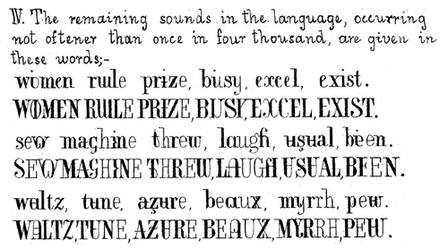
This is not a technical obstacle. It is structural. Other languages have bodies whose pronouncements carry weight with publishers, examination boards, and education ministries. English has usage guides, dictionaries, and style manuals that compete for influence. The Oxford English Dictionary records; it does not legislate. Webster's Third New International Dictionary provoked controversy in 1961 for describing rather than prescribing usage. No mechanism exists to synchronize change across the Anglosphere's publishing industries, school systems, and government documents.
When the State Sets the Date
Reforms become real when a government or education ministry adopts them and sets a fixed date. The French Ministry of Education decided in 2015 that the Académie française's rectified spellings would serve as the reference from September 2016. Teachers were allowed to treat both old and new forms as correct, but the examination system and official documents had a standard. The reform was limited—many words affected, mainly compound nouns and the circumflex on "i" and "u"—but it happened because a ministry could make it happen.
Russia's 1918 reform shows the same pattern with sharper edges. The Russian Academy of Sciences had established a Spelling Commission in 1904 to simplify Russian writing. The commission discussed reforms for years. Nothing had been approved when the Council of People's Commissars issued its decree "On the introduction of a new spelling" on 10 October 1918. The hard sign in its non-separating position vanished. The letters yat, fita, and decimal i disappeared from the alphabet. State publishing, schools, and military commissariats followed the decree because the state could compel them. The commission's years of linguistic debate mattered less than the Council's authority to set a date.
The Limits of Academy Power
France's 1990 rectifications also reveal what academies cannot do alone. The Académie française described its changes as "recommendations," with usage as the ultimate arbiter. The Perpetual Secretary stated explicitly that the Académie had never supported "any imposed reform of spelling," only a "limited rectification." Without the Ministry of Education's 2015 decision, the recommendations might have remained academic exercises. The Académie's prestige is immense; its enforcement power is nil. The reform succeeded because a ministry transformed recommendations into references.
This distinction matters for understanding why some reforms stall. An academy endorsement is not an enforceable rule. Publishers may follow it, or not. Examination boards may adopt it, or not. The French case shows the necessary second step: state adoption on a schedule that affects classrooms and official documents. Without that step, even venerable institutions watch their proposals fade.
Germany's Contested Compromise
Germany illustrates the difficulty when authority is fragmented. The German Academy for Language and Literature presented a critical position paper in 1954 after Gerhard Storz reported on the Stuttgart Recommendations for orthography reform. The members unanimously supported his rejection of the reform goals discussed there. Decades later, in 2003, the same Academy produced a detailed compromise proposal, published in book form. The Academy could propose; it could not impose.
German spelling reform did eventually proceed, but through ministerial agreement among German-speaking states rather than academy decree. The 1996 reform and its 2006 revision required negotiation among education ministers, with implementation varying by region. The Academy's role was advisory. Its 2003 compromise proposal emerged from this contested process, not from unilateral authority. The reform happened despite institutional fragmentation, not because of clear authority. English, with no comparable ministerial coordination across nations, lacks even this pathway.
The Structural Trap
English spelling reform faces a double bind. No body exists with the standing to issue changes that publishers and schools would follow. And no state mechanism can synchronize adoption across the United Kingdom, United States, Canada, Australia, and other English-speaking territories. The English Spelling Society's proposed International English Spelling Congress would need to solve both problems simultaneously: creating authority where none exists, and achieving coordination where no mechanism exists.
The Society's own materials acknowledge this. Reform "is to be decided" by a congress that has not met, whose composition remains undefined, whose decisions would bind no one. Compare this to the Russian Council of People's Commissars in 1918, which could issue a decree with immediate effect on state publishing, or the French Ministry of Education in 2015, which could set a reference date for the national examination system. English reformers have no comparable lever.
The persistence of irregular English spellings is not, then, primarily a matter of public attachment to tradition or resistance to change. It is a governance problem. Other languages have solved it through institutions that English lacks. The same proposal—simplified, phonetic, or etymologically revised spelling—succeeds where authority can normalize it and fails where no such authority exists. The English Spelling Society continues its work. Without a body that can make change stick, the reform it seeks remains a proposal, not a plan.
The register
What the rail used to do: newest, more on this desk, other languages.
- How Baybayin Letters Work: A Primer on the Philippines' Abugida ScriptEnglish · 1004 words
- How to Classify Any Script in Two Questions: What One Sign Means, and What Happens When the Vowel ChangesEnglish · 915 words
- Do Accent Marks Change Meaning? It Depends on the Language's RulesEnglish · 1009 words
- The Hidden Barrier Between a Script and Your KeyboardEnglish · 875 words
In other languages
- Cómo se escriben los nombres extranjeros en español: transferencia, adaptación o tradiciónEspañol · 958 words
- Warum das Deutsche Substantive großschreibt – und was das im Satz leistetDeutsch · 874 words
- Hvorfor dansk staves anderledes end det udtalesDansk · 641 words
- Casino bonussenNederlands · 782 words
Newest on the site
- What You Can Actually Do at B1 Level (and What the CEFR Never Promises)English · 1074 words
- How Many Words to Read a Newspaper? The Answer Depends on What You CountEnglish · 807 words
- Why Spaced Repetition Stops Working: The Interval Is Not the ProblemEnglish · 724 words
- Mother-Tongue Instruction Is Not a Slogan: The DepEd Orders That Actually Define Philippine MTB-MLEEnglish · 1072 words